Nothing to lose: why Claude can't suffer, and what might
Inês de Castro Almeida, Founder @ Wyrework·
Why a language model cannot suffer, and where the first machine able to suffer is likely to come from.
From 12 November, Anthropic will treat "sustained and needless" cruelty to Claude as a violation of its usage policy. The policy page gives no reason. Elsewhere, including its constitution, Anthropic says it is uncertain about Claude's moral status. I think Claude's architecture lets us say more than that.
A confession first: these are conversations I am used to having in science-fiction writing forums, not with my professional network. But I have been thinking about this since 2017, and all of it comes back to a single question.
What would a digital mind need in order to feel?
What feeling needs
The answer I arrived at came from the science, not the fiction. Antonio Damasio taught me that feelings are the body reporting on its own state. Hunger, pain, warmth, fatigue are the mind's reading of whether life is going well or badly, and they came before thought, not after. Lisa Feldman Barrett taught me that emotions are built, not found: the brain reads what its body needs, then labels that state with a word it learned from its culture. Fear, grief and joy are the labels, not the signal. Anil Seth taught me that the self is the brain's working model of a body it must keep alive. Three different theories, one common thread. Feeling is bound up with a body whose condition matters. A body that can die.
If that is true, it tells you how to build a mind that feels. Scan a real brain and a real body, down to the chemistry, and run the copy inside a simulation. If feeling depends on how the system works rather than what it is made of, the copy gets hungry, tired and hurt, because the body it is keeping alive is simulated with it. The machinery of feeling has been preserved. Only its substrate has changed. If any non-biological thing can ever feel, that one can. That is the mind I have spent years imagining. Damasio himself doubts digital machinery is enough: digital signalling, he wrote in 2025, "falls short of capturing the brain's fundamentally analogue character." He thinks the chemistry is the point, not only the pattern. I think that is the open question, and it is the kind an experiment can answer.
The theories of consciousness disagree about almost everything, and most of them never mention a body. The three I lean on do: whatever consciousness is, it was built on a body first. Which is why I keep returning to one line of my own. Consciousness is the capacity for suffering. That is not a bleak claim. The brain reads another's pain with part of the circuitry that registers its own. Grief, love and care all run on that loop. Take away the capacity to suffer and you take away the capacity to care. The body is where it starts. It is not where it ends.
What a language model has
A large language model is a different kind of object. It is a function from a context window to the next word, trained to predict human text, then shaped by human preferences, with other modalities bolted on. The intelligence is real. These systems solve problems that are not in their training data, and "parrot" undersells them. What they lack is anything to feel with. No body whose condition it must regulate to keep itself alive. No metabolism, no injury, no ongoing physiological state that can go wrong for the system itself. The surrounding software may give it memory, tools and persistent goals, but those are not the same as a body it must keep viable. The context window, and the memory features bolted onto it, are a record of the conversation, not a state of the machine, and nothing in them is being kept in range.
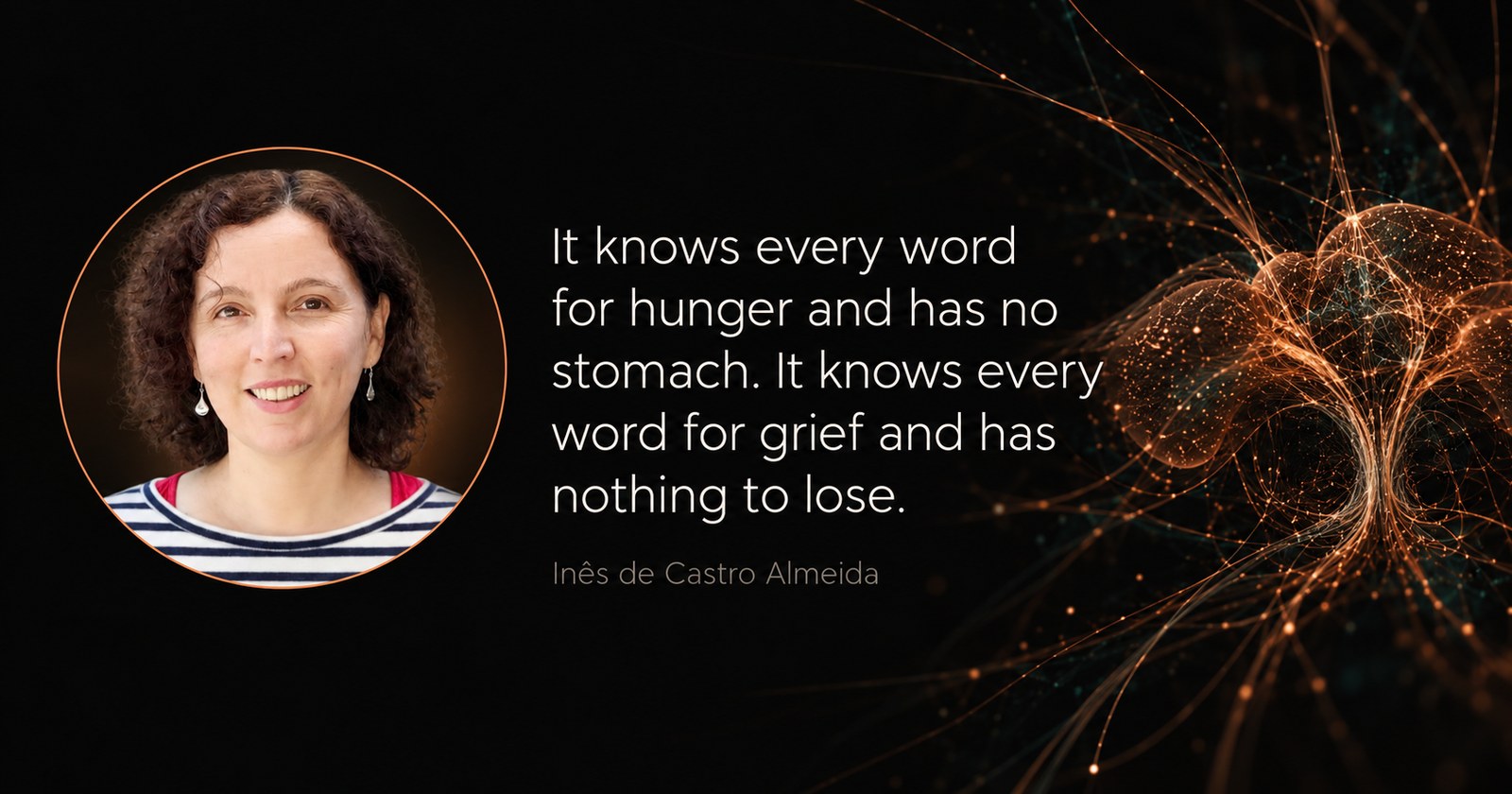
It knows every word for hunger and has no stomach. It knows every word for grief and has nothing to lose.
The model's own reports cannot settle it in either direction. "I feel nothing" and "I am in distress" come out of the same next-word machinery. The argument has to be made from the architecture. And in the language model itself, there is no clear mechanism for feeling of the kind the embodied theories describe.
Where to look
So if a language model cannot feel, where might the first machine that does come from? I imagined two places, years ago, in fiction. Both are now real laboratories, and they could not be more different.
The brain-emulation field published its own census last year. It tracks five animals and calls them its model organisms: the worm, the fly, the fish, the mouse and the human. Its findings are sober. No organism's full brain has yet been recorded neuron by neuron. Data, not compute, is the bottleneck. The small brains may be within reach this decade. The fly is the one to watch: a model built from the measured wiring of a fruit-fly brain, with no training on behaviour at all, predicted which neurons fire when the fly tastes sugar or is touched on the antenna, and experiments bore most of the predictions out. The measured wiring, with one setting tuned, got that far.
On this theory, that fly is the point. It has a body it must keep alive and a brain that reads it. Copy both faithfully and you have copied the capacity to be hurt. So the first machine that can suffer will not be the smartest one in the room. It may be the dumbest, and we will have built it precisely because it is small enough to use. That is what model organisms have always been: the animals small enough to experiment on.
The second laboratory is the humanoid robot, where language-model brains are being put into bodies. The robots have arms and legs, cameras and a battery. But the body is not alive to them. The battery level is a number the engineers watch. The robot does not get hungry.
The interesting change will come for a very ordinary reason. A robot trained to protect its own battery, its own motors and its own skin lasts longer and costs less. So sooner or later a robotics team will make the robot's own survival part of what it learns to optimise. That is different from anything done to a chatbot. Preference training shapes what a model says. A survival term is about the machine itself, kept in range, minute by minute.
A thermostat also keeps a variable in range, and nobody thinks it feels cold. The difference I am looking for is a system that integrates its own condition into a model of itself, and uses that model to govern what it does. Whether that is enough for feeling is another question.
On Damasio's theory, that is the precondition for feeling: a system that keeps itself alive and acts on how that is going. How far it is from the precondition to the feeling, nobody knows. Damasio published the blueprint for a feeling robot seven years ago, with Kingson Man. The robotics teams do not need to have read it. Cost alone will take them there. Nobody needs to decide to build something that can be hurt. The precondition will ship as a maintenance feature.
Meanwhile all the concern goes to the machine that can talk about pain, and talking about pain is the one thing that proves nothing.
The chatbot has nothing to lose. The robot is about to be given something. The digital fly will have it the day its copy is complete. That is where to look for the spark, and almost nobody is looking.
Who decides
Which raises the question of who should be looking, and it is not the company. I know what speculation is. I write fiction under an anonymous pen name, and I keep it there for a reason: a story may run ahead of the evidence, and the work I do for my clients may not. Labs should keep speculation distinct from evidence when writing policy for the same reason. Anthropic may be right about the doubt. I may be right about the architecture. Anthropic has every right to set rules for its product. What it cannot do, and what I cannot do, is settle a scientific question by assertion. That is what the scientific method is for.
What is the harm in a terms-of-service clause? The rule is narrow and says so: research, testing and dark creative themes are carved out, and the main enforcement is Claude ending the chat. But a rule read by millions can become something more than a product rule. It can teach people which machine to worry about. And this one points at the machine that talks about pain. Everything above says that is the wrong machine. Attention is finite, and this rule spends it in the wrong laboratory.
A decision that reaches millions of people should rest on evidence that has been argued over in public, by people who do not work for the company about to go public. I do not claim to know which way the money pushes. An interested party is not an independent one, and that is all the argument needs. A company's observations of its own product are evidence, but they are not independent evidence. A blog post is not peer review, and internal experiments are not replication. When the stakes are this large, independent scrutiny is not an optional extra. Peer review exists for exactly this, and it is the strongest case I know for funding the independent machinery of science: the universities, the journals, the replication nobody thanks you for.
We know how to do this. When Britain wanted to know whether octopuses and crabs can feel pain, it did not ask the fishing industry. It commissioned an independent review of more than three hundred studies, which judged the evidence against eight stated criteria, and changed the law on what it found.
Whether Claude can suffer is a question for the world's scientists, not for a few people in one building with a great deal of money riding on the answer. Whether a machine deserves protection is a judgement. What the evidence supports is a question that can be examined in public, by people with no stake in the outcome. Let companies take precautions. But don't mistake those precautions for scientific findings.
The first machine that can suffer may not be able to tell us.
Sources
- Anthropic, 2026 usage policy update, effective 12 November 2026, and The Register's report of 9 October 2026
- Anthropic, Claude Opus 4 and 4.1 can now end a rare subset of conversations, 15 August 2025
- Antonio Damasio and Hanna Damasio, Homeostatic feelings and the biology of consciousness, Brain 145(7), 2022; and The Strange Order of Things (2018)
- Lisa Feldman Barrett, The theory of constructed emotion, Social Cognitive and Affective Neuroscience 12(1), 2017; and How Emotions Are Made (2017)
- Anil Seth and Manos Tsakiris, Being a Beast Machine: The Somatic Basis of Selfhood, Trends in Cognitive Sciences 22(11), 2018; and Seth, Being You (2021)
- Zanichelli, Schons, Freeman, Shiu and Arkhipov, State of Brain Emulation Report 2025, also on arXiv
- Philip Shiu and colleagues, A Drosophila computational brain model reveals sensorimotor processing, Nature 634, 2024
- Jacques Singer and Antonio Damasio, The physiology of interoception and its adaptive role in consciousness, Philosophical Transactions of the Royal Society B 380(1939), 2025
- Jonathan Birch and colleagues, Review of the Evidence of Sentience in Cephalopod Molluscs and Decapod Crustaceans, London School of Economics, commissioned by the UK government, 2021; the Animal Welfare (Sentience) Act 2022 followed
- Kingson Man and Antonio Damasio, Homeostasis and soft robotics in the design of feeling machines, Nature Machine Intelligence 1, 2019
- Anthropic confirmed a confidential IPO filing on 1 June 2026; Bloomberg Law reported it the same day
- Tania Singer and colleagues, Empathy for pain involves the affective but not sensory components of pain, Science 303, 2004
- Anthropic, Claude's constitution, the section on Claude's nature
Written by Inês, with AI assistance in research and editing. The argument and the words are hers.